The whole journey, arranged so the road stays the point.
It is not a guided trip, and it is not a track file on its own. It is the day already worked out, with the practical detail in the same place as the road.
01The whole route, stage by stage.
02Distances and realistic riding times.
03The stops that earn their place.
04Where to stay and where to eat.
05What to know before each day starts.
06GPX files for your own navigator.
Roads Unleashed21:04
The day
The day, stage by stage
First stageRoute
Second stageRoute
A key stopA wide lay-by at the roadside, with the whole valley in front of you.
The note you want before setting off: what to expect on the road, and what to check first.
An example of the day view. A real day is not published on this site yet.
The route
The stops, one by one.
Every stop in the roadbook has been ridden to and stood at. These are the ones on this route.
Feddan Parking TetouanParking
Café JENINCoffee stop
Restaurant Bab SsourFood
TotalEnergies DARDARARefuel
APIA Café & RestaurantBreakfast
station shell mkanssaCoffee stop
Mirador de la medina de FezViewpoint
Medina de Ouezzane / Zaouia Moulay Abdellah CherifHeritage
Café Restaurant LA PAIXCoffee stop
Cèdre Gouraud / Bosque de cedros de AzrouViewpoint
Mirador de las gargantas del ZizViewpoint
TotalEnergies ErfoudRefuel
Ruta en quad por las dunas de Erg ChebbiViewpoint
Gara Medouar / Cárcel portuguesaHeritage
Ksar de Ait Ben HaddouHeritage
Jardín MajorelleHeritage
Madrasa Ben YoussefHeritage
Palacio de la BahíaHeritage
Medina y zocos de MarrakechHeritage
Plaza Jemaa el-FnaHeritage
Mezquita Hassan II de CasablancaHeritage
Embarque ferry Tanger Med - AlgecirasFerry
The route, day by day
Every day, already worked out.
What each day asks of you, what to check before setting off, and where to stop for a reason. The places open into their own guide.
Day 1
Tanger Med - Chefchauen
126 km
Customs, the first bends of the Rif and arrival in Chefchauen in daylight.
Before you set off
Today you cross into Morocco, and that matters more than the road. Keep your paperwork to hand from the hotel: passport, permit, insurance and green card. There is a queue at customs, so set off with a margin and without rushing. Once you are through, the link to Tetouan is quick, and from there the Rif bends begin, with local traffic and one village after another: the exit roundabouts are where it is easiest to take the wrong direction, so check the map before you enter. The climb to Chefchauen is gentle; if you do it in daylight, you enjoy it. If night catches you, slow down and do not push: there is more road tomorrow.
Day 2
Chefchauen - Fez
212 km
From the Rif to the plain: a transit day with service stops and arrival in Fez.
Before you set off
Today you leave the mountains and drop to the plain. The first part is all bends and the second opens into long straights, with more traffic, checkpoints and lorries. Today's stops are not visits: they are coffee, fuel and stretching your legs. Refuel when you see a station, not when you are running low, because here the distances between towns are misleading and not every filling station that appears on the map is open. The arrival in Fez is in dense traffic and with big roundabouts: go in calmly and find your accommodation without improvising. Tomorrow is the longest day of the trip, so eat and sleep well tonight.
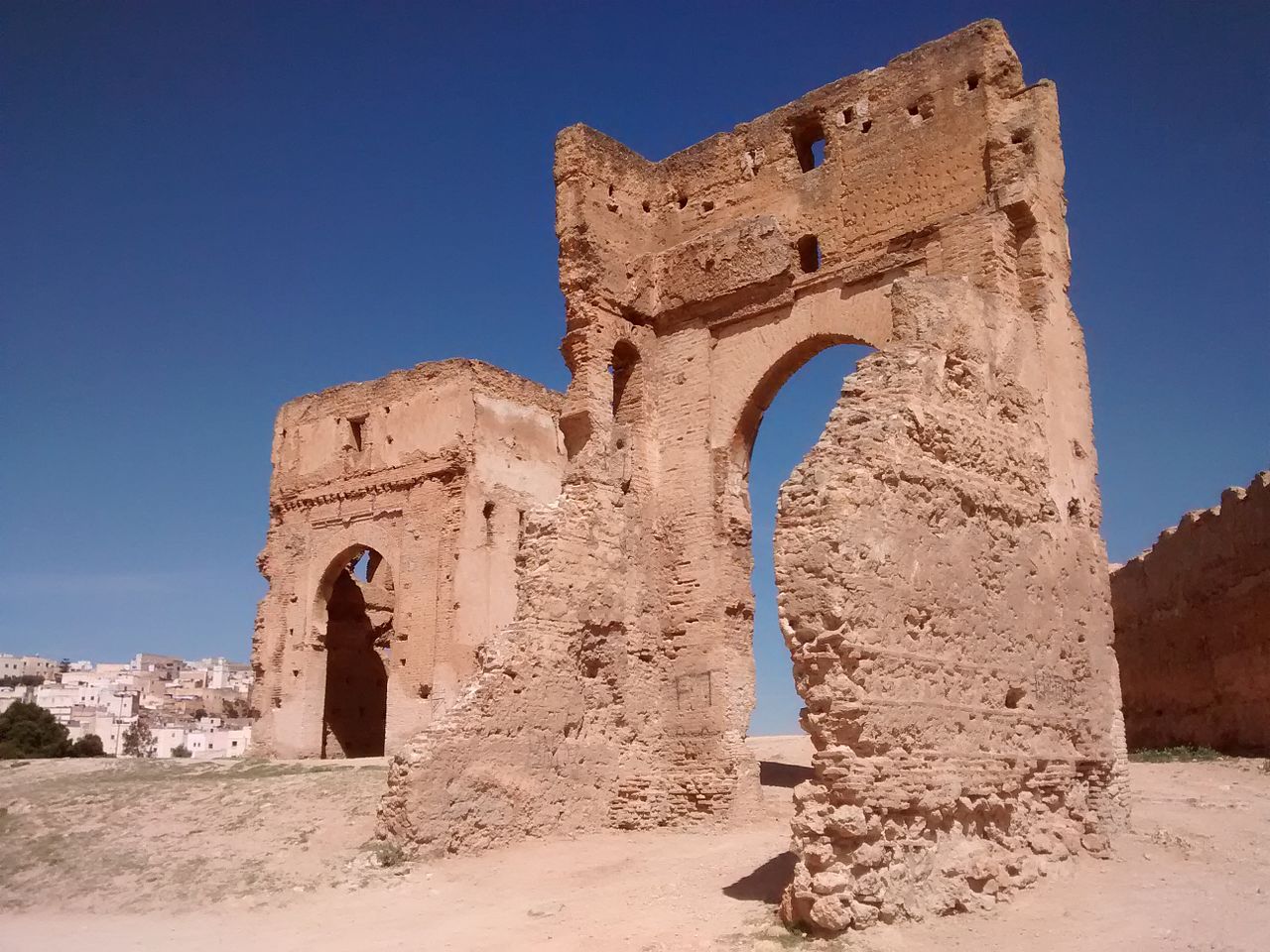
Mirador de la medina de FezViewpoint
The Marinid tombs: the whole of Fez before you go inside
What it is: You climb a short slope from the road, leave the bike and the city appears at once, whole, with no gap between rooftops. It is the first time in the day that you see Fez complete, and it changes the idea you had brought with you: it is not a large city, it is a labyrinth of centuries packed into a valley.
What you have in front of you are the Marinid tombs, the royal necropolis of the dynasty that ruled Morocco between the 13th and 15th centuries. Today they are ruins, two masses of stone on the hill, and for decades they have worked as the classic viewpoint over Fez el-Bali, the old city. They stand north of the medina, on high ground, and that is why the view is clean.
Below stretches Fez el-Bali, the historic medina, with its sea of rooftops and its minarets. To one side lies the new city, with wide streets and traffic. The contrast between the two explains Fez better than any explanation: there is no transition here, just two cities stuck together.
The necropolis is in ruins because time and earthquakes wore it down, but it keeps its position: it was built where it was built to command the city, and it still does.
Why it is here: This viewpoint is not a decoration of the day: it is how you understand where you are about to go next. Coming down from here and entering the medina means something else once you have seen its size from above.
How to use the stop
With wind, it blows harder up here than below. Do not leave your panniers loose or your helmet on the seat if it is blowing hard, because this is an open hill.
Before you go down it is worth deciding where you leave the bike. The medina does not take loaded bikes: the streets are narrow, there are steps everywhere and there is nowhere to turn comfortably. The sensible thing is to park in the upper area or beside one of the gates and walk in with what you are wearing. Riding down to the wall to save yourself a hundred metres of walking is the quickest way to make the day complicated.
When to cut it short
It is worth it whenever you arrive with light, even if you only have half an hour. The climb is short and the place is roomy, so it costs you nothing. If you arrive at night or with the day already over, there is no point forcing it: without light there is no view and the hill has nothing else.
Medina de Ouezzane / Zaouia Moulay Abdellah CherifHeritage
Ouezzane: the holy city almost nobody looks at while passing
What it is: The road climbs north from Fez and Ouezzane appears as an unassuming provincial city: rooftops packed onto a slope, real traffic, people shopping. It is the capital of its province, in the Tanger-Tetouan-Al Hoceima region, and it has around sixty thousand inhabitants. At first glance it does not look like a place to stop, and yet it is one of the cities with the greatest religious weight in the country.
In the Islamic world it is known as an important spiritual capital of Sufism, and it is also called Dar Dmana. For Moroccan Jews it is a holy city: they make the pilgrimage here to venerate the tombs of marabouts, in particular that of Moul Anrhaz, the 18th-century rabbi Amram ben Diwan, whose tomb carries miraculous legends. That explains how such a discreet place holds so much history inside.
Ouezzane lives on wool, olive groves and wood. Its wool industry and its production of oil and olives are what sustain the local economy, along with woodworking workshops. It is not a showcase city: it is a city that works.
That is why its medina is walked differently from those of Fez or Marrakech. There is no tourist circuit laid on here: there are streets where people live their lives and where the traveller is a visitor, not a customer.
But it is worth knowing that this grey outline north of Fez was a French military base during the Rif rebellion in the 1920s, and that it was linked by narrow-gauge railway to Kenitra. Almost none of that can be seen today, and that is precisely the interest.
Why it is here: This stop falls on a long day heading north or south, and it is not a halt for sightseeing: it is a stop to understand where you are.
How to use the stop
It is enough to get off the bike, walk the medina for a while and eat something, without looking for anything in particular.
When to cut it short
If you are short of time, you ride through the city and carry on.
Day 3
Fez - Merzouga
475 km
The longest day: the Middle Atlas, the Azrou cedar forest, the Ziz gorges and the entry to the desert.
Before you set off
Today you ride all day. Leave early, seriously: there are many km ahead and they do not forgive delays. First you climb into the Middle Atlas among cedars and the air turns cold; in the Azrou cedar forest there are Barbary macaques beside the road and they are wild animals in danger of extinction, so do not feed them and do not leave your panniers open. Then comes the plateau with wind and after that the descent of the Ziz, where the heat appears all at once: ride through the tunnel in single file, without stopping inside. The last hour, already in the desert, is dirt and dust. If you are tight for time, cut stops, never the arrival.
Cèdre Gouraud / Bosque de cedros de AzrouViewpoint
The Azrou cedar grove: the forest where the macaque lives
What it is: You can smell the cedar before you see it. The road enters a forest of tall, twisted trees, with the ground covered in branches and cones, and the temperature drops a few degrees. Azrou lies 18 km south-west of Ifrane, inside this forest, and the Gouraud cedar is the best-known specimen of the forest: a singular Atlas cedar with a name of its own.
But what really makes this forest famous is not the trees: it is its inhabitants. In the Azrou cedar grove lives a population of Barbary macaques, an endangered species. They are easy to see because they come close to the road, and precisely for that reason it is worth knowing how to behave.
Why it is here: This is one of those places you do not visit: you ride through it. And riding through it well means going slowly, not touching the animals and leaving the forest with your bike and your luggage intact.
How to use the stop
Do not feed them. A macaque fed by humans stops looking for its own food, loses its fear and ends up depending on whoever passes; it also becomes demanding and can turn aggressive if it gets nothing. Feeding them is the quickest way to harm them.
Do not let them get near your luggage. They are quick, their hands are skilful and they have learned that bike bags hold food. If they surround you, do not shout and do not make sudden movements: back away slowly and get on the bike.
This forest is high and the temperature drops compared with the plain. If you come from the plateau in the heat, you will feel the change in your gloves. This is the moment to take out the extra layer and adjust it before carrying on, not after twenty km of being cold.
In rain or fog, the surface in the forest turns shiny from shade and resin. Ride slower and with more margin, because there is no shoulder here and the trees stand right against the road.
What it is: You come from the plateau, from km of straight road with wind, and suddenly the road cuts into a rock gorge. Below, the Ziz palm grove appears, long and green, following the riverbed. It is one of the sharpest changes of landscape on the trip, and it happens in a few minutes.
The road that crosses these gorges is the Ziz route, the one that links Midelt with Erfoud. At its narrowest point it passes through the Foum Zabel tunnel, cut into the rock and named after a legionnaire who died during the works. That detail explains quite well how this road was built: with effort and time, not with easy alignments.
Why it is here: The palm grove you see from above is not a backdrop: it is an inhabited valley, with earth-built villages and irrigation channels that carry river water to the orchards. The road leaves them behind one by one as it descends, and at every bend a different village appears with its minaret and its shade. Riding slowly here pays off, because the section ends sooner than it seems and after that everything is flat.
This section is the perfect example of why Morocco is worth riding slowly: the landscape does not change because of what you visit, it changes because the road takes you from one world to another in twenty minutes.
How to use the stop
It is a short tunnel, but it sits in an area of bends and slow traffic, with large vehicles crossing it in both directions. It is no place to stop or to overtake: you go through, you look and you carry on.
The road loses height towards the palm grove and the heat rises as you descend. What was cool air up top becomes dry heat below, so the section asks you to adjust your clothing at some point.
There are widened sections and viewpoints along the descent, as long as visibility is good and there is room to leave the bike off the road. There a short stop is worth it: the palm grove from above is the best of the section and you see it in two minutes.
When to cut it short
What is not worth it is stopping inside the tunnel or on a blind bend to take a photo. The view repeats further down, and with space.
Day 4
Merzouga - Merzouga
A day without the bike: dunes, an optional activity and rest.
Before you set off
Today you do not take the bike. The day is yours: you can do the dune activity or stay at the accommodation doing nothing, and both options are correct. Use the time to wash clothes, check the bike calmly — chain, pressure, filter — and sleep. Have lunch and dinner at the camp. Tomorrow there is another very long day, so today's rest is not a reward: it is part of the trip.
Ruta en quad por las dunas de Erg ChebbiViewpoint
Erg Chebbi by quad: an activity, not a road section
What it is: this entry covers a booked activity in the Erg Chebbi area, not a road you should link to the following day. The Moroccan National Tourist Office presents Merzouga as the gateway to the dunes and lists the quad among the possible experiences. That confirms the context of the destination, but it does not confirm a specific provider, a price, a duration or the state of the route on your date. The entry's point is placed on the dune system as a geographical reference; the stop's link keeps the operational navigation that already exists.
Why it is here: day 4 is planned as a stay in Merzouga. You can swap the rhythm of the bike for a short ride on sand, book a guided excursion or simply rest. The decision here is to keep a recreational experience separate from a road route: no fictional km are added, no activity is promised as included, and the outing is not forced if heat, wind or tiredness make it pointless.
Rough timing: A window of two or three hours can serve as a rough guide, but the real offer and daylight come first.
How to use the stop
Confirm with the provider the meeting point, the real duration, the route, the type of quad, the helmet and the rest of the gear. Ask about cancellation and about the return to your accommodation. Do not take it for granted that the outing has supervised parking for bikes: leave the bike in a legal and stable place.
Check water, sun protection, goggles and a phone protected from dust.
Do not mix the activity with a road stage and do not navigate by the sand alone.
If the provider does not explain safety, gear or the return, do not book.
Erg Chebbi lets you change the intensity without turning the day into an obligation. A sunrise or sunset walk, a sandboarding session or a camel caravan can fill a shorter window; Dayet Srij and the oasis add a reading of the landscape if conditions allow. The real offer, the gear, the transfer and the return are confirmed locally.
If you prefer culture, combine Rissani and Gara Medouar only with clear access and a clear vehicle. The Moroccan National Tourist Office also places the Erg Chebbi museum of nomadic culture and the heritage of Rissani, Sijilmassa and the fossils in the region. They are options to decide with, not a list that has to be completed.
Skipping the quad does not leave the day incomplete. You can use the day for maintenance, rest or a short walk around Merzouga. Do not replace an unavailable activity with an improvised ride into the dunes on your travel bike: the terrain, the heat and the navigation change the demands. With strong wind, a sandstorm or fatigue, keep a margin and come back in daylight. Check the official context for Merzouga and Erg Chebbi; the specific conditions are confirmed with the provider on the day.
Decision: Mark the quad as an optional or recommended experience, not a commercial obligation. The place coordinate serves for knowledge of the location and the stop's navigation remains independent. If it fits: a clear provider, confirmed gear and a return in daylight. That way the day keeps three honest layers: stay, activity and road route.
What it is: Gara Medouar, also called Jebel Mudawwar, is a rock formation in the province of Errachidia with a closed, recognisable outline. Its value for the traveller lies in reading the relief and the landscape, not in inventing a confident story out of a nickname. The popular name 'Portuguese prison' must not be presented as proof that a Portuguese prison once stood there. This entry keeps that caution so as not to turn oral tradition into checked experience.
Why it is here: day 4 has no road route. The formation can work as an optional excursion from Merzouga if a local provider knows the access and the state of the track. The place coordinate identifies the geographical point and the stop keeps its own navigation link; they are different layers. The real time depends on the track, the vehicle, the heat and the margin for the return, so no fixed duration is promised.
How to use the stop
Ask your accommodation or a local guide with current knowledge of the access. Confirm whether the track is passable, whether you can get there on your travel bike or whether it is better to hire a vehicle, and where you can leave the bike safely. Do not take signposted parking, shade, phone coverage or facilities for granted. Carry water, enough fuel, sun protection and an offline map.
Set off with enough daylight to get back to Merzouga.
Avoid riding alone over unknown ground or in wind that erases tracks.
Respect any property, crop, sign or local instruction.
If the excursion is planned towards Rissani, the mausoleum of Moulay Ali Chérif and the remains of Sijilmassa add historical context; the fossil and mineral museum on the road adds a short option if it is open. Gara Medouar can be the landscape landmark of the same block, but a visit along a track must not be mixed with a road route or an improved access promised.
Confirm with your accommodation or a local guide whether it is better to arrive in a hired vehicle, whether the track is passable and where you leave the bike. If the access, the time or the return are not clear, keep Merzouga as a stay day. The name 'Portuguese prison' stays a popular name and not an accredited historical fact.
When to cut it short
Gara Medouar is the first stop to cut if the access is not clear, if it is too hot or if you have already used the day to rest. There is no penalty for not getting there: the trip keeps its logic because the day is a stay. It is also skipped if the only reason is to repeat the name 'Portuguese prison' with no source to support it. Check the Gara Medouar category on Wikimedia Commons and the structured DBpedia entry; they are references, not permission to enter or a guarantee of the state of the track.
Decision: Treat the formation as an optional excursion for geological and historical reading, not as a compulsory section. The entry helps locate it and set limits on the story; the stop should lead to a confirmed operational destination. If there is no clear provider, access and return, Merzouga offers a better decision: rest, maintenance and preparation for the next stage. The regional cultural reference is checked against the official information from the Moroccan National Tourist Office.
Day 5
Merzouga - Ouarzazate
456 km
A long crossing of the south: Tinghir, the Dades gorges and arrival in Ouarzazate.
Before you set off
Second long day in a row with no planned stops: today you ride. The route climbs through Tinghir, enters the gorge section and continues through Boumalne towards Ouarzazate, with technical bends and lorries in places. As there are no planned stops, set two service halts yourself: one for fuel and one to eat something standing up. Drink water all day, not only when you stop. The arrival is late and in fading light; go into the city calmly and park the bike before dinner. Today there is nothing to prove: the goal is to arrive in one piece.
Day 6
Ouarzazate - Marrakech
211 km
Ait Ben Haddou, the Telouet pass and the descent to Marrakech.
Before you set off
Today you ride fewer km, but harder ones. The first stop is Ait Ben Haddou, a fortified ksar listed as a World Heritage Site: you walk up, in closed footwear and without weight, and you have to remember that some families still live inside. Then comes the Telouet pass, with real bends and a surface that changes, and the long descent towards Marrakech. On the way up and on the way down, ride in your own lane and do not gamble on an overtake: this is a road to enjoy slowly. The arrival in Marrakech is in dense traffic with many small bikes; go in calmly and park until tomorrow.
Ksar de Ait Ben HaddouHeritage
Ait Ben Haddou: the fortified town that is still alive
What it is: You see it from the road before you arrive: a mass of rammed earth climbing a hill, with square towers and black openings for windows. It lies in the province of Ouarzazate, in the Draa-Tafilalet region, and it stretches along the Ounila river. It is a ksar, a fortified town, and it is listed as a World Heritage Site.
What many people do not expect is that it is not an empty monument. Most of its inhabitants live today in the new village on the other side of the river, but some families are still inside the walls. That changes the visit: you are not walking through a film set, you are walking through a place where people still live.
The walls are made of earth and straw, and they are kept standing by repairing them every year. That fragility is part of what keeps the whole site standing and part of what makes it necessary to conserve it with care.
Why it is here: This is the big stop of the day and it deserves time, but not unlimited time.
After days of road, this place reminds you that the trip is also about seeing how other people live. Here you do not have to imagine it: it is in front of you and still in use.
Rough timing: A long hour is enough to see the whole site, climb to the top and come down calmly.
How to use the stop
The streets are narrow, steep and made of earth, with uneven steps and covered passages that connect one house to another. There is no single route: you go up wherever you can and come down wherever it opens. Wear closed footwear and do not carry weight, because the ground is slippery when it is dry and turns to mud when it rains.
You can cross the river over the stones, although with high water it is better to go where the local people tell you. And you do not ride up on the bike: leave it parked below, in the designated area, and walk up.
When to cut it short
If the day is loaded, forty well-used minutes are still worth it.
Day 7
Marrakech - Marrakech
A day without the bike in Marrakech: medina, gardens and rest.
Before you set off
No bike. The city is covered on foot and by taxi, and the best approach is to order the visits with the heat in mind: first what opens early and then what has shade. Write down the hotel name and address on your phone and on paper, because in the medina the streets look alike and the signal does not always help. At night, the square is the natural place for dinner. Tomorrow you are back on the road, so do not end up exhausted.
What it is: the Majorelle Garden is a botanical garden and cultural space in Marrakech associated with the blue villa and the collection linked to Yves Saint Laurent.
Why it is here: on a day based in one place it offers a concrete visit, but it is separated from the medina by an urban transfer. Count the ticket, the walk, the exit and the return. The Place coordinate identifies the garden; the Stop keeps its own operational navigation. The bike must be left in a legal and stable place, without assuming that the garden offers guarded parking.
Rough timing: Allow 45-75 minutes as a planning guide for a relaxed visit, on top of travel and waiting.
How to use the stop
Book only through the official channel and choose a time that fits the rest of the day. Take the minimum with you, protect the bike outside the visit area and respect the staff.
Check the entry time before you set off.
Leave a margin for walking and for city traffic.
Do not buy from third-party links that imitate the official channel.
The Majorelle entry can serve as a doorway to the rest of the stay: you can choose between the heritage interiors of Ben Youssef, Bahia, El Badi and the Saadian Tombs; walk the medina and the souks; finish at Jemaa el-Fna; or change the tone with the Menara, Le Jardin Secret or the Gueliz and Hivernage districts. The decision is not to pile up names, but to choose two experiences that let you come back calmly.
El Badi Palace, the Saadian Tombs and the Menara pavilion have ticket information from the Ministry of Culture. Le Jardin Secret publishes its own practical information. Check opening times and prices at the official source you have chosen, leave the bike outside the pedestrian core and count the walk there and back.
Majorelle or the Menara bring air and garden; Ben Youssef, Bahia, El Badi and the Saadian Tombs concentrate heritage; the medina, the souks and Jemaa el-Fna bring a living city. Gueliz and Hivernage work as a low-demand exit. If the city has already used up your attention, resting is also a correct option.
When to cut it short
If there are no tickets, the queue is excessive or the heat is pressing, skip the garden without treating the day as failed. You can give the day to two interiors in the medina, walk the souks or rest. The honest decision is to explain the conditions, not to sell the idea that everything fits into one morning. Check the official Majorelle Garden information before closing the plan.
Verifiable fact: The official website states daily opening from 8:30 to 18:00, last entry at 17:30, and directs ticket purchase to its official platform. These are planning facts, not a promise of spontaneous entry or of no queue. ONMT Marrakech, El Badi, Saadian Tombs, Menara and Le Jardin Secret.
Decision: Majorelle is recommended when the ticket is confirmed and the transfer fits the margin. Place provides its own coordinates and Stop provides its own navigation; neither one on its own confirms parking. That way you know what has been checked and what has to be checked again.
Decision: the visit works best as the first decision of the day, when the ticket is secure and you still have energy to walk. If the time you chose forces you to cross Marrakech in a hurry, change the order or drop it. The value is in visiting the garden calmly, not in adding it to a list of places that are then rushed through.
Madrasa Ben YoussefHeritage
Madrasa Ben Youssef: go in with time, come out unhurried
What it is: the Ben Youssef Madrasa is a former centre of Quranic teaching in Marrakech, rebuilt and opened as a monument.
Why it is here: it is a clear indoor visit for a day with no route. Its courtyard and decoration justify walking to it, but not adding every palace and garden in the same block. The coordinate identifies the madrasa and the Stop navigation should take you to the permitted entrance. The bike stays outside the pedestrian area: do not assume there is reserved parking by the door.
Rough timing: Allow 45-60 minutes for the visit, plus walking there and finding your way through the medina.
How to use the stop
Choose Ben Youssef as one of the two interiors of the day. Wear comfortable shoes, respect the silence and the signs of the monument and park before entering the pedestrian area.
Check the official hours and Ramadan if it applies.
Count the return to the bike as part of the visit.
Do not combine three interiors if the day starts late.
When to cut it short
It can be replaced by an exterior reading of the medina and a pause. If there is a queue, heat or tiredness, keep the simple decision: one interior visited well and the rest on foot. Check the official opening times and rates and the institutional presentation before closing the plan.
Verifiable fact: Its official website places its origin in the 16th century and publishes general opening hours of 9:00 to 19:00, a different window during Ramadan and rates for foreign visitors. The real time, the capacity and any change of access are checked before you set off.
Decision: The entry turns a name into a concrete decision: ticket, time, walk and cut. The Place coordinates do not replace the Stop navigation and neither one on its own confirms parking. Choose the madrasa with a margin and do not chase it at the cost of the return.
Decision: the courtyard, the details and the silence deserve a pause without a stopwatch. You do not need to memorise every element for the visit to make sense: it is enough to observe the scale of the whole and let the medina set the next step. If the walk has already taken you too long, keep the exterior reference and come back with a margin.
What it is: the Bahia Palace is a palace complex in Marrakech arranged around courtyards, gardens and decorated rooms.
Why it is here: it fits as an alternative or a complement to Ben Youssef, not as an obligation added to all of Marrakech. It requires walking from wherever you leave the bike. The coordinate locates the complex; the Stop keeps its own operational navigation. Do not take motorcycle parking by the door for granted: park legally outside the pedestrian flow.
Rough timing: Count 30-60 minutes depending on crowds and which rooms are open.
How to use the stop
If you have already chosen Ben Youssef, treat Bahia as a second interior and not a third obligation. Arrive before the published closing time, dress respectfully and follow the staff.
Check hours and price at the official source.
Leave the bike in a legal spot and note the way back.
If the queue grows, the exterior and the medina still work.
When to cut it short
If you are late, it is hot or the entry is unclear, skip the interior and keep the neighbourhood experience. Do not make up time by speeding between souks or riding across pedestrian areas. Day 7 does not need to prove that every place was ticked off. Check the official ticket platform before closing the plan.
Verifiable fact: The Ministry of Culture ticket platform publishes reference hours of 9:00 to 17:00. It is useful for planning, but the hours, the price, the access points and the crowds are checked on the day of the visit.
Decision: Bahia is optional for anyone who still has a margin. Place and Stop have different jobs: one entry explains the place and the other helps you navigate. The safe decision is to walk from a permitted parking spot and to cut the visit if the hours or the crowds complicate the return.
Decision: the courtyards offer a short, welcome reading when the heat presses, but the shade must not become an excuse to stretch the day. Choose the rooms that are open, listen to the staff and keep time to walk out. The experience improves when the palace is a concrete choice, not one more accumulated visit.
Medina y zocos de MarrakechHeritage
Medina and souks: walk without chasing every street
What it is: the medina of Marrakech is a historic fabric of streets, workshops, markets and monuments. The Moroccan National Tourist Office presents the souks as a space of crafts and trade, while UNESCO recognises the medina as world heritage.
Why it is here: a day with no route needs a flexible walk. The souks work between visits, but they are not an itinerary with a finish line. The coordinate points to the Semmarine area and the Stop keeps its own operational navigation. Leave the bike outside the pedestrian core in a legal and stable place. No specific spot, no special security for luggage and no fixed duration are promised.
Rough timing: A window of 45-90 minutes may be enough for a first reading.
How to use the stop
Choose one entrance, fix a return point and walk with your phone and documents protected. If you buy, agree the price and check what you can carry without loading the bike unsafely. Respect pedestrians, sellers, workshops and places of worship.
Note where you left the bike before entering the passages.
Avoid accepting services or detours you have not decided on.
If the heat rises, pause or turn back: you do not have to complete the map.
When to cut it short
Cut the medina if you have already visited two interiors, if your concentration drops or if shopping adds tension. You can limit yourself to one main street, have a drink and go back to your accommodation. The experience does not improve by walking more km around the city. Check the official shopping information and the description of the Marrakech medina on UNESCO; neither replaces observing the real conditions.
Verifiable fact: its urban and cultural value; the experience depends on the time, the density, the heat and which shops are open.
Decision: The medina works as an open, adaptable route. The entry fixes a reference and the stop helps with operational access, but the bike stays outside the pedestrian space. The souks are a choice of walking and shopping, not a promise of parking, a private guide or a complete route.
Decision: the souks are enjoyed more with a simple limit than with a shopping mission. Decide what you want to look at, how much weight you can carry and what time you will come back. A short walk, a clear conversation and a return without getting lost add more to the trip than crossing every passage with your attention worn out.
What it is: Jemaa el-Fna is the great square of the Marrakech medina and a space for gathering, trade, storytelling and performances that changes throughout the day. It is not the same attraction at every hour: light, activity, noise and density change the experience.
Why it is here: it fits as a flexible close to the day based in the city. Arriving in the late afternoon lets you walk and decide whether you have energy left to have dinner. The bike must be left outside the pedestrian core in a legal and stable place. Do not assume reserved parking, luggage surveillance or a uniform atmosphere.
Rough timing: A visit of 30-60 minutes may be enough to watch the light change and decide whether you stay.
How to use the stop
Leave time to walk from wherever you park and agree on a return point. Keep your documents close, avoid visible objects on the bike and respect the people who work in the square. If you have dinner, choose calmly and check the price before ordering.
Go while there is enough light to get back to the bike.
If it is too crowded or you are tired, move to a quiet street.
Do not turn the square into a photographic obligation.
When to cut it short
Skip it if you have already had enough city, if the heat does not drop or if the return gets complicated. The square should close the day, not add a final race. You can see it on a short route and go back early, or leave it for another visit. Check the UNESCO entry to understand the value of the place, but decide according to the real state of the afternoon.
Verifiable fact: UNESCO recognises its cultural space as intangible heritage and its link to the entrance of the medina.
Decision: the square is an afternoon recommendation, with a simple way out and back and no motorcycle route that day. If the city has already used up your attention, finishing earlier is also a good decision: there are no km to recover, rest is part of the trip and the heat of the medina argues against pushing. To widen the reading of the place, this reference remains: UNESCO — cultural space of Jemaa el-Fna square.
Day 8
Marrakech - Rabat
320 km
Motorway north: Casablanca, the Hassan II mosque and arrival in Rabat.
Before you set off
A linking day on the motorway: more monotonous, but it is what takes you north. Keep your distance from the lorries and do not let the rush to finish early carry you away. The stop of the day is the Hassan II mosque in Casablanca: park as a group and facing into the wind, look at the esplanade and move on without stretching it, because there is still road ahead. On entering Rabat, refuel even if you think you have enough: tomorrow you leave early and you will not want to be looking for a filling station with the ferry waiting.
Mezquita Hassan II de CasablancaHeritage
Hassan II Mosque: a scale you do not understand until you are underneath
What it is: You come in along the seafront with the damp Atlantic air stuck to your helmet and, suddenly, the minaret. Two hundred metres high above an esplanade you cannot quite measure with your eyes. It is not a pretty picture: it is a bulk that forces you to look up and slow down, and on the last day of a trip that is welcome.
The building stands on an artificial island reclaimed from the ocean, and that decision is not decorative: it answers a verse of the Quran that places the throne of Allah over the water. Once you know that, the position of the temple stops being a whim and becomes the key to the whole complex.
Why it is here: This stop falls on the day heading north, already on the way to the ferry. It is not the day for a long visit: it is the day to see something big with your luggage on and carry on.
Casablanca is not like the cities you have crossed these days: here the traffic presses, the distances are long and the bike stops being the main character. The mosque is the exact counterpoint to the medinas of the interior, and that is why it works as a closing: after days of narrow streets, this is air and vertigo.
How to use the stop
Take a walk around the esplanade, look at the facade from the water and spend a while with the sound of the sea, which sounds different here than in the south.
When to cut it short
If you are in a hurry, the short stop is enough and leaves no feeling of having passed it by. If you have time, the complex can be walked calmly, but do not turn it into the excuse for arriving late for the ferry.
Verifiable fact: It was inaugurated in 1993 and at the time its minaret was the tallest in the world among temples. The prayer hall holds around 25,000 people and the outer esplanade around 80,000. The complex covers nine hectares and the interior exceeds 20,000 square metres.
Verifiable fact: Behind it are figures that are hard to imagine: 53,000 square metres of carved wood, more than 10,000 of mosaic and between fifty and eighty million hours of work. The roof opens, the floor is heated and the doors are electric, with anti-seismic reinforcement throughout the structure. Besides the prayer hall there is a library, a Quranic school and a museum.
Day 9
Rabat - Algeciras
280 km
Last stage: the link to Tanger Med and boarding.
Before you set off
Last day. Leave early because the ferry does not wait: the link to Tanger Med is motorway and you have to arrive with a margin, not just in time. Refuel before the port. There is a queue at customs and you go through with your paperwork in hand, without rushing and without arguing with anyone: keep the papers where you can reach them without getting off the bike. Inside, follow the signs for the ferry and leave the bike where they tell you. With the bike strapped down and your helmet in your hand, the trip is already done.
We do not sell a line on a map. We sell a day that already works.
What is included
Everything you need to ride it
The route, stage by stage, with the stops that earn their place.
Distances and realistic riding times for each day.
Where to stay and where to eat along the way.
GPX files for your own navigator, and the route on your phone.
Access for a set period, with the start date you choose.
What is not
And what stays yours
A guide. Nobody rides with you: the route is the guide.
A group. You set the pace, the stops and the start of each day.
Bookings. We tell you where to stay; booking it is yours.
Travel to the start, fuel and meals.
How it works
Three steps. Then it is yours.
Choose the route. Pick your start date inside the access period. Get your link by email and open the first day when you are ready.
The contracting conditions are already published. Access is not on sale yet: when a route opens for sale, its price, its access period and its checkout appear on its own page, before anyone can pay.